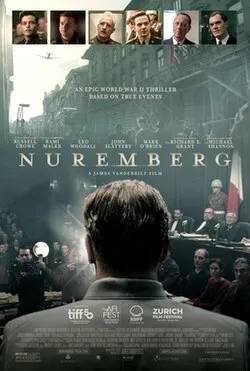
Kelley was a real U.S. Army psychiatrist and amateur magician brought to Nuremberg to evaluate the Nazi defendants for fitness to stand trial. The film accurately captures his dual motivation. Genuine scientific curiosity about the psychology of evil alongside a personal ambition to write a bestselling book about the experience. He did eventually publish 22 Cells in Nuremberg (1947). The film dramatizes his bond with Göring more than the historical record supports, but the access he had to the defendants and his fascination with Göring are well documented. Although the film implies consequences for leaking sensitive information to a journalist named Lila, in reality Kelley was never fired or reprimanded, he was promoted and commended for his efforts at Nuremberg. This journalist has no historical equivalent.
Russell Crowe's performance is the heart of the film and is grounded in solid historical research. Göring really was the dominant personality among the defendants. He was charming, insanely intellectual, and utterly remorseless. His willingness to hold court with psychiatrists and journalists, his successful detox from paracodeine addiction during the trial, his victory over Jackson during cross-examination, and his final suicide by cyanide the night before his execution are all accurate. The film does compress his time on the witness stand into what feels like a single day, but in reality it stretched over several days.
Jackson was the real U.S. Chief Counsel and a sitting Associate Justice of the Supreme Court. Michael Shannon plays him as unyielding and idealistic, which matches the historical record. His cross-examination by Göring, which Göring effectively won, is depicted accurately. Some reviewers felt Shannon's portrayal leaned too heroic and underplayed Jackson's actual frustration and occasional missteps at the tribunal. A scene showing Jackson meeting the Pope has been flagged by historians as likely fictional.
Triest is one of the lesser-known figures the film brings to life and one of its best decisions. He was a real German-Jewish refugee who had fled Nazi Germany as a child, immigrated to the United States, and ended up serving as an Army interpreter at the very trial of the men responsible for the Holocaust. The emotional weight of his position, standing feet away from Göring and the other defendants, is exactly as extraordinary as it sounds.
Andrus was the real American colonel in charge of the defendants' custody. John Slattery plays him in a heightened, somewhat theatrical way that some reviewers called over the top. The real Andrus was indeed a strict, no-nonsense officer obsessed with security protocols, but the film punches his rigidity up for comedic effect. His fury over Göring's suicide on his watch was very real though.
Gilbert was a real Army psychologist who worked alongside Kelley at Nuremberg. Colin Hanks plays him as Kelley's more measured counterpart. Gilbert's published work Nuremberg Diary (1947) which includes IQ scores, direct conversations with defendants, and observations from the screening of concentration camp footage, is one of the most valuable primary sources on the trial. The film accurately depicts the professional tension between Kelley and Gilbert over access and methods.
Emmy Göring was a real figure, a former actress and Hermann's second wife, whom he married in 1935 in a ceremony that was essentially a Nazi state event. She was deeply loyal to him throughout the trial and genuinely believed until the end that he would be acquitted. Kelley acted as an informal courier between Göring and his family, which the film depicts accurately. She survived the war and lived until 1973.
Kelley really was brought to Nuremberg to conduct psychiatric evaluations of the defendants and determine their fitness to stand trial. He had unprecedented access to 22 of the most powerful war criminals in history, access no psychiatrist had ever had before or since. His goal, as described by the Smithsonian, was to determine whether the Nazi leaders shared a psychiatric condition that led them to commit mass atrocities. He concluded they did not. That ordinary men had committed extraordinary evil, which is one of the film's central and most historically grounded themes.
Kelley did develop a complicated relationship with Göring that went beyond clinical detachment. He served as a courier for Göring's letters to his family, conducted extensive private conversations, and later wrote about him with a degree of intellectual admiration that unsettled many readers. The film dramatizes this into something closer to a genuine friendship, which is probably a stretch, but the dynamic of a psychiatrist becoming more invested in a patient than was professionally appropriate is documented. Kelley later dying by suicide in 1958 using the same type of cyanide capsule as Göring, just makes the whole thing a little more off-putting.
The November 29, 1945 screening of Nazi documentary footage, including footage shot by Allied forces at liberated concentration camps. Is one of the most documented moments of the entire trial. The defendants' reactions ranged from visible distress to denial to looking away. Gilbert recorded each defendant's response in his diary. The film's inclusion of actual historical footage during this sequence is one of its most powerful and historically correct choices.
Göring's cross-examination by Jackson is one of the most well-documented moments of the trial and the film captures its essence accurately. Göring was well-prepared, articulate, and turned the exchanges into a platform for Nazi ideology for days. The tribunal eventually had to step in and require shorter answers. Jackson himself acknowledged in letters that Göring had bested him. The film compresses the timeline, it played out over several days, not one but the dynamic is accurate.
One of the film's most resonant moments to me, Kelley's warning that the conditions and psychology that produced Nazism could take hold in America is rooted in what he actually wrote and said. His 1947 book argued that the Nazi leadership were not psychiatric aberrations but recognizable American personality types driven by ambition and a lack of moral restraint. The film dramatizes this as a direct warning that nobody wants to hear, which is somewhat exaggerated, but the underlying argument is genuinely his.
Göring swallowed a cyanide capsule on the night of October 15, 1946 - hours before he was scheduled to hang. To this day, nobody knows with certainty how he obtained the capsule. Theories include a sympathetic guard, a hidden compartment in a jar of skin cream, or a visitor. Colonel Andrus was furious. The film depicts this accurately, including the ambiguity around how the capsule was smuggled in.
The real Courtroom 600 still exists. The Palace of Justice in Nuremberg is still a functioning courthouse today. Courtroom 600 is open as a memorial and museum. You can sit in the actual room where Göring and the others were tried.
Göring's cyanide capsule is still a mystery. To this day, no one knows how Göring obtained the cyanide. It was found hidden in a brass cartridge case. Theories range from a sympathetic guard to a hidden compartment in a jar of skin cream he was allowed. Colonel Andrus was reportedly livid.
The simultaneous translation was invented for this trial. IBM developed the four-channel simultaneous interpretation system specifically for Nuremberg. Each participant wore headphones and could dial between English, French, Russian, and German. It was the birth of modern conference interpretation.
Göring's IQ was measured at 138. Dr. Gilbert administered IQ tests to all the defendants. The average among them was 128. Schacht scored highest at 143. Göring came in second at 138. Streicher (the one who we saw get hung) came in lowest at 106. Gilbert published all of this in Nuremberg Diary.
The ashes of the executed were dumped in a river - secretly. To prevent any grave from becoming a Nazi shrine, the bodies of the ten executed defendants were cremated and their ashes were scattered into the Isar River at a classified location. The location remained secret for decades.